I have a love/hate relationship with my grandmother’s shortbread. It’s delicious to eat, and maddening to make.
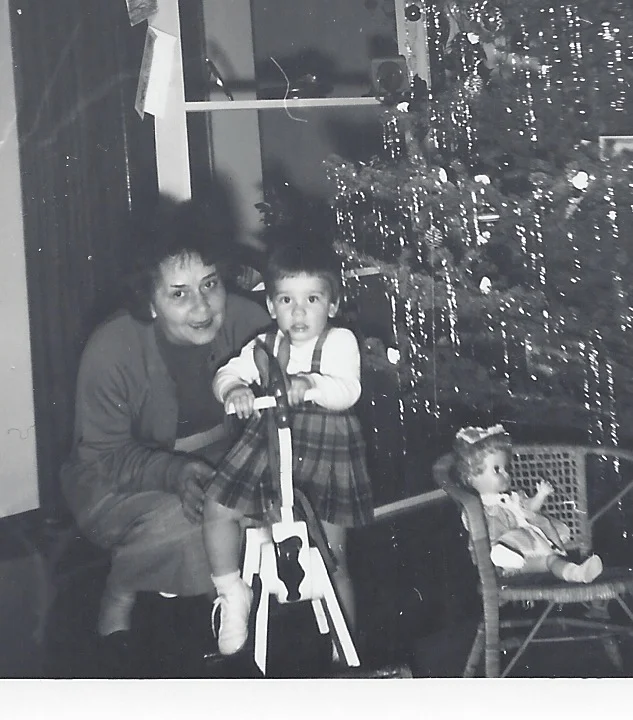
My grandmother was a shortbread snob. No quick-and-dirty recipe for her. She disdained those light, insubstantial cookies made with icing sugar and whipped together in an electric mixer. Her shortbread was dense and serious, the ingredients worked together by hand. Real Scottish shortbread, she would say with her chin lifted and her gaze unwavering, daring you to disagree. She often made pronouncements like this, backing them up with evidence she had polished into glinting certainties. Calling her out on her prejudices and closely held truths was a kind of sport in our family. But when it came to shortbread, what was the point of arguing? Though my grandmother wasn’t a Scot, I never doubted her recipe was the genuine article. She wouldn’t have settled for anything less. And, of course, the proof of the cookies was in the eating.
Long after my grandmother died, I attempted her recipe. Not just to carry the tradition forward, but to satisfy a deep craving for one of the delights of my childhood. The cookies were rich with memories. The icy early morning drive downtown with my father on deserted fluorescent-white streets to meet the night bus from the Okanagan. My grandfather smiling and rosy, my grandmother disgruntled and fussing. The slow reveal of the shortbread stowed in my grandmother’s suitcase: undoing the crisscross of elastics strapped around an old Pot of Gold chocolate box, pulling away the layers of paper towel swaddling. The first bite of the pale, precious cookies she had carried across the Rocky Mountains because I had asked.
The first few batches failed. I wasn’t surprised. Very little about my grandmother was easy.
A few years ago, I decided to give shortbread another try. I was writing about my grandmother then and the way her legacy of high expectations and rigid confidence was tightening around me. As I tried to turn my memories into stories, the material resisted me. After countless drafts, a narrative was beginning to emerge. Something was happening to me, too. As I loosened myself from my grandmother, I was finding a new way to love her.
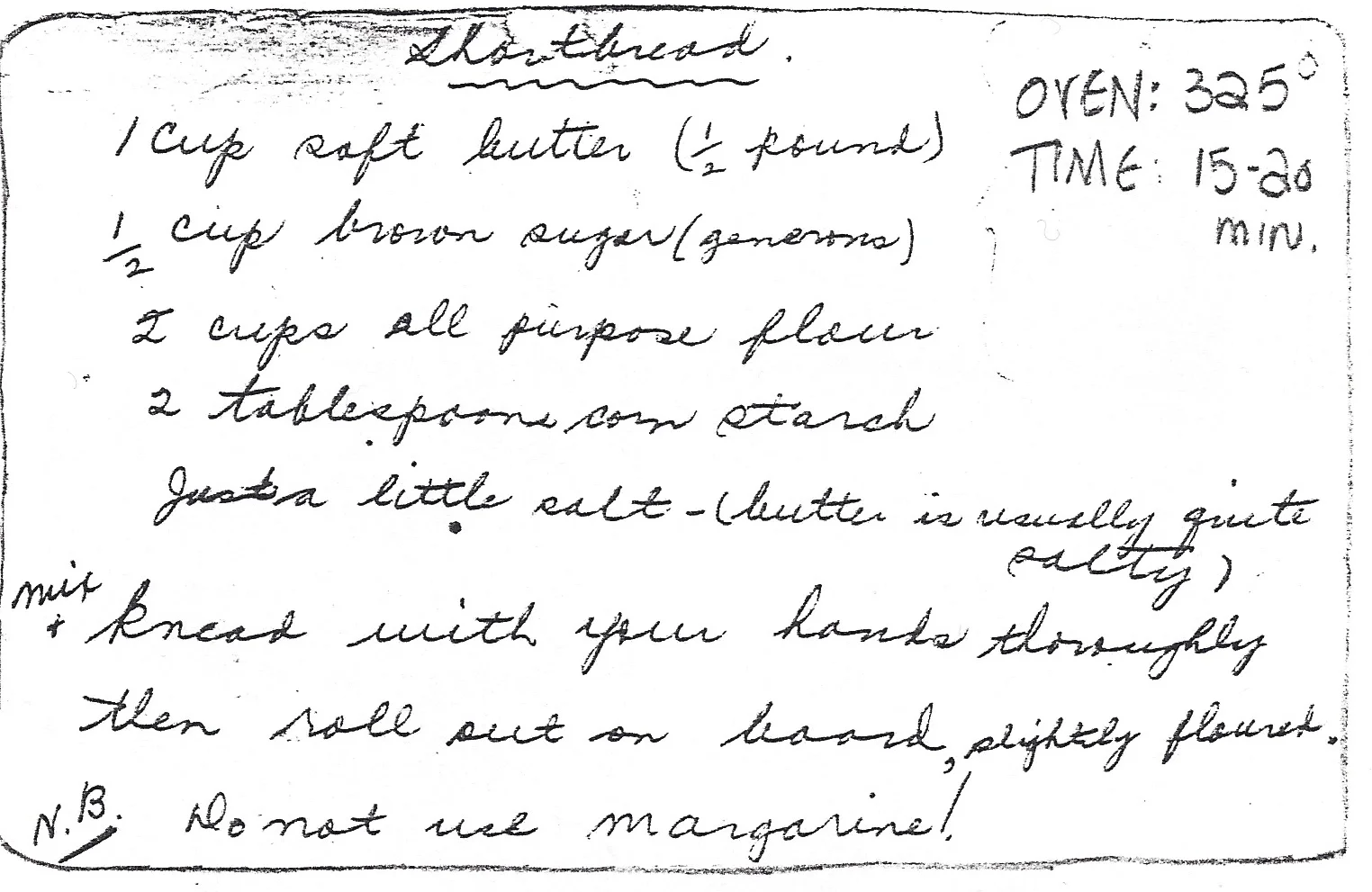
This time, I measured the ingredients carefully, following her handwritten recipe to the letter. The butter was soft; the brown sugar, generous. I added the flour, cornstarch and, as instructed, just a little salt. Poised over the mixing bowl with my sleeves pushed up, I checked the recipe. Mix and knead with your hands thoroughly. My old frustration prickled. How long was “thoroughly”? I expected more than this vague adverb from a woman who had been so exacting.
I kept going. “Thoroughly” meant working harder and longer than I thought was necessary. “Thoroughly” was not giving up until I satiated my hunger. My fingers ached, but the dough was still loose and dry. I beckoned my better, more mindful self. I kneaded. I breathed. I let go. As I surrendered myself to my grandmother’s shortbread, the dough turned into a smooth, warm, pliable ball.
My baker self was jubilant, and so was the writer. As the aroma of shortbread filled the house, I grabbed a scrap of paper. My hands sticky with dough, I scribbled down the details of this new, unexpected chapter.
Last Christmas, I was lighthearted as I set out to make shortbread. Not only had I found the knack of my grandmother’s recipe, I was in the final stages of a manuscript centred on our relationship. I had completed a book with a beginning, middle and end – obstacles encountered and overcome. The shortbread played a starring role as a metaphor for the way my grandmother’s bitter legacy had turned into something more sweet.
But this time, as I worked the dough, the ingredients refused to come together. I persevered, dumping the dry mass on the counter. The old story. I cursed as the dough fell apart under my rolling pin. Why couldn’t the shortbread play along with my narrative? I salvaged a few of the cracked, misshapen cookies and threw the rest in the trash.
Christmas is coming. Instead of baking, I have been writing about shortbread. I thought I could whip together a seasonal essay – something light and insubstantial – but the story isn’t cooperating. I work and rework it, pull it apart, put it together, pull it apart again. Every time I think it’s finished, the essay splits open.
Take charge of your nonfiction story, an expert says. Find the controlling idea. There is no shortcut to good storytelling, just years of practice, failure and study of the discipline.
A memory pushes through the cracks. My grandmother curled over one of her crochet projects, ripping apart the stitches and starting all over, scowling because her vision of the thing she set out to make eludes her. It's just a blanket, I’d say as she held her project too tightly, trapping herself in the imperfect results of her labour.
Christmas is here and I am hungry for my grandmother’s damned shortbread. I’ve found a new recipe, posted online by Shirley Gardiner from Clearwater, Manitoba. She uses the same ingredients as my grandmother, but her instructions are more precise. I admit: I like Shirley's tone, too. She promises these cookies are a snap to make.
As I write, a pound of butter softens on the kitchen counter.